ABOUT E-BOOK
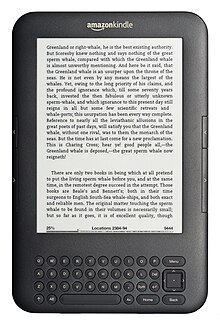
An electronic book (variously, e-book, ebook, digital book, or even e-edition) is a book-length publication in digital form, consisting of text, images, or both, and produced on, published through, and readable on computers or other electronic devices.[1] Sometimes the equivalent of a conventional printed book, e-books can also be born digital. The Oxford Dictionary of English defines the e-book as "an electronic version of a printed book,"[2] but e-books can and do exist without any printed equivalent. E-books are usually read on dedicated e-book readers or general purpose computer tablets. Personal computers and many mobile phones (most smart phones) can also be used to read e-books.
E - BOOK FORMATES
Numerous e-book formats emerged and proliferated, some supported by major software companies such as Adobe with its PDF format, and others supported by independent and open-source programmers. Multiple readers followed multiple formats, most of them specializing in only one format, and thereby fragmenting the e-book market even more. Due to exclusiveness and limited readerships of e-books, the fractured market of independent publishers and specialty authors lacked consensus regarding a standard for packaging and selling e-books.
However, in the late 1990s a consortium was formed to develop the Open eBook format as a way for authors and publishers to provide a single source document that could be handled by many book-reading software and hardware platforms. Open eBook defined required subsets ofXHTML and CSS; a set of multimedia formats (others could be used, but there must also be a fallback in one of the required formats); and anXML schema for a "manifest", to list the components of a given ebook, identify a table of contents, cover art, and so on. Google Books has converted many public-domain works to this open format.
In 2010 e-books continued to gain in their own underground markets. Many e-book publishers began distributing books that were in the public domain. At the same time, authors with books that were not accepted by publishers offered their works online so they could be seen by others. Unofficial (and occasionally unauthorized) catalogs of books became available over the web, and sites devoted to e-books began disseminating information about e-books to the public.[19]
ADVANTAGES
Over 2 million free e-books were available between July 4 and August 4 in 2009.[62] Mobile availability of e-books may be provided for users with a mobile data connection, so that these e-books need not be stored on the device. An e-book can be offered indefinitely, without ever going "out of print". In the space that a comparably sized print book takes up, an e-reader can potentially contain thousands of e-books, limited only by its memory capacity. If space is at a premium, such as in a backpack or at home, it can be an advantage that an e-book collection takes up little room and weight.
E-book websites can include the ability to translate books into many different languages, making the works available to speakers of languages not covered by printed translations. Depending on the device, an e-book may be readable in low light or even total darkness. Many newer readers have the ability to display motion, enlarge or change fonts,[63] useText-to-speech software to read the text aloud for visually impaired, partially sighted, elderly or dyslectic people or just for convenience, search for key terms, find definitions, or allow highlighting bookmarking and annotation.
While an e-book reader costs much more than one book, the electronic texts are at times cheaper. Moreover, a great share of e-books are available online for free, minus the minimal costs of the electronics required. For example, all fiction from before the year 1900 is in the public domain. Also, libraries lend more current e-book titles for limited times, free samples are available of many publications, and there are other lending models being piloted as well. E-books can be printed for less than the price of traditional new books using new on-demand book printers.
DIS-ADVANTAGES
E-book formats and file types continue to develop and change through time, through advances and developments in technology or the introduction of new proprietary formats. While printed books remain readable for many years, e-books may need to be copied or converted to a new carrier or file type over time. Because of proprietary formats or lack of file support, formatted e-books may be unusable on certain readers. PDF and epub are growing standards, but are not universal.
Paper books can be bought and wrapped for a present and a library of books can provide visual appeal, while the digital nature of e-books makes them non-visible and intangible. E-books cannot provide the physical feel of the cover, paper, and binding of the original printed work. An author who publishes a book often puts more into the work than simply the words on the pages. E-books may cause people "to do the grazing and quick reading that screens enable, rather than be by themselves with the author's ideas".[66] They may use the e-books simply for reference purposes rather than reading for pleasure and leisure.[67] Books with large pictures (such as children's books) or diagrams are more inconvenient for viewing and reading.
A book will never turn off, can last for several decades or longer and would be unusable only if significantly damaged. The shelf life of a printed book exceeds that of an e-book reader, as over time the reader's battery will drain and require recharging. Due to faults in hardware or software, e-book readers may malfunction and data loss can occur. As with any piece of technology, the reader must be protected from the elements (such as extreme cold, heat, water, etc.), while print books are not susceptible to damage from electromagnetic pulses, surges, impacts, or temperatures typically found in automobiles on a hot day.
The cost of an e-book reader far exceeds that of a single book, and e-books often cost the same as their print versions. Due to the cost of the initial investment in some form of e-reader, e-books are cost prohibitive to much[quantify] of the world's population. Furthermore, there is no used e-book market, so consumers will neither be able to recoup some of their costs by selling an unwanted title they have finished, nor will they be able to buy used copies at significant discounts, as they can now easily do with printed books. Because of the high-tech appeal of the e-reader, they are a greater target for theft than an individual print book. Along with the theft of the physical device, any e-books it contains also become stolen. E-books purchased from vendors like Amazon or Barnes & Noble.com are stored "in the cloud" on servers and "digital lockers" and have the benefit of being easily retrieved if an e-reading device is lost. Not all e-booksellers are cloud based; if an e-book is stolen, accidentally lost, or deleted, in the absence of a backup it may have to be repurchased.
there are some useful links of e book free download sites....use it......
www.ebookee.org
www.bookchums.com

No comments:
Post a Comment